
What You’ll See Now: Spotting Native Wildflowers in Local Woods
This post was written by guest blogger Toni Bailey, owner and Landscape Architect of Gracefully Green LLC. Toni specializes in sustainable landscaping.
It’s officially fall, a delightful season in the Washington metro area – the weather is pleasant and dry, and the heat and humidity of summer are gone. Don’t wait for our beautiful native trees to change color; get out right now to see native wildflowers kick off the fall season. Explorations in Rock Creek Regional Park provide much to appreciate. If you head out soon, here’s what you are likely to see. All of the photos are of plants found in Rock Creek Regional Park in September 2017.
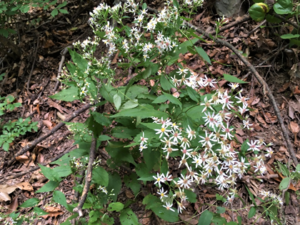
White Wood Aster (Eurybia divaricata)
A charming, tiny, daisy-like flower that prefers shade and attracts butterflies.
Bluestem Goldenrod (Solidago caesia)
You can guess which one of these is the goldenrod: the yellow one, of course. You’ll often see them as you do here, near the white wood asters. They like the same conditions, shady spots with plenty of leaf litter. It attracts birds and beneficial insects. Hurry to see this one – it’s fading fast.
Spicebush (Lindera benzoin)
Spicebush is a graceful large shrub that prefers shade and is one of the few that deer are less interested in. It makes yellow flowers in spring before the leaves emerge, followed by a glossy red fruit. Here it’s showing its yellow fall color. Spicebush attracts birds and butterflies and is a host plant to the Eastern Tiger Swallowtail and the Spicebush Swallowtail.
Virginia Jumpseed (Persicaria virginiana)
A woodland groundcover, Virginia Jumpseed can be found in shade. It gets its name from the tendency of the seed to jump off the plant. It attracts butterflies, but not deer.
Jewelweed (Impatiens capensis)
We have a native impatiens, and this is it, an annual just like the exotic ones more commonly planted in gardens. You can find it in damp shade, being visited by hummingbirds, songbirds, butterflies, and beneficial insects.
White Snakeroot (Ageratina altissima)
White Snakeroot has lovely small white flowers that stand out for their pure whiteness. It gets its common name due to the fact that Native Americans used it as a treatment for snakebites. However, a person who drank milk from a cow that fed on the plant would develop an illness called “milk sickness.” So just look at it; don’t eat it. Butterflies like it; deer, not so much.
Woodland Sunflower (Helianthus divaricatus)
The bright yellow petals of Woodland Sunflowers stand out at the edges of woods, where they bloom from August into September. Butterflies, songbirds, and bees seek it out.
Sensitive Fern (Onoclea sensibilis)
Sensitive Fern isn’t just a Fall plant; it emerges in May-June and persists until frost. A dependable forest groundcover, it provides benefits for salamanders, frogs, and birds.
Common Boneset (Eupatorium perfiolatum)
Boneset is another white-flowering perennial that adds bright spots to the woodland landscape. Its leaves were once used to heal broken bones, either by making a tea of them or wrapping the leaves on the injury. The plant attracts birds and butterflies.
Rough-leaved Goldenrod (Solidago rugosa)
Here’s the familiar Goldenrod that you see at the edges of woods, in fields, and along roadsides, mistakenly thought to cause hay fever. Birds, butterflies, beneficial insects, and mammals are attracted to it.
Blue Mistflower (Conoclinium coelestinum)
Pretty blue-lavender flowers adorn a low-growing woodland plant. Bees, birds and butterflies are drawn to it.
Here’s A Bonus!
A really splendid mushroom growing on a dead tree. I’m no expert, but I think it’s a Sulphur Shelf mushroom. If you find one, don’t eat it, but do admire it.
If you like the plants you’ve seen, you may be tempted to grow them in your own gardens. Many of them are available in nurseries or at native plant sales. Resist the temptation to remove them if you see them in the wild. They are unlikely to thrive in a cultivated setting, and in the forest they are a part of a finely-calibrated ecosystem. Out there, they are much more than pretty; they are life-sustaining. But definitely, take a hike and seek them out. Finding them, and others, will enrich your experience.
Related Posts:
Beautiful, Beneficial Native Plants for Maryland
Native Plants To Be Thankful For In Your Landscape
Remember, Allentuck Landscaping Co. is always here to help you design, install, construct and maintain you lawn and landscape. Give us a call!
Allentuck Landscaping Co. is Your Residential Landscape Company
Phone: 301-515-1900 Email: info@allentucklandscaping.com
At Allentuck Landscaping Co., our mission is to create beautiful environments for people to enjoy. We see landscaping as a way to improve people’s lives.
The Allentuck Landscaping Co. team has been delighting homeowners in Maryland, Washington DC and Northern Virginia for over 28 years with our turnkey approach to landscape design, installation, construction and maintenance. Most companies try to serve many types of customers at the same time; homeowners, shopping centers, office buildings and the list goes on. At Allentuck Landscaping Co., we focus on one customer, you, the homeowner. We have a singular focus on bringing you the best landscape practices, the best customer service, and the best value for your home.
Services Provide – Master Landscape Plans, Complete Maintenance Programs, Plantings, Patios, Walkways, Retaining Walls, Water Features, Outdoor Lighting, Outdoor Kitchens, Trellises & Pergolas, Irrigation Systems, Drainage Solutions, Grading & Sodding. Fire Pits & Fire Places, Spring Clean Ups, Decks, Fences
Areas Served – Chevy Chase, Bethesda, Potomac, Rockville, North Potomac, Darnestown, Gaithersburg, Germantown, Boyds, Clarksburg, Ijamsville, Urbana, Frederick and Washington DC.