
Please ensure Javascript is enabled for purposes of website accessibility

Why Do I Have Brown Areas In My Lawn?

Fertilizer spreader

Brown Patch Thrives in Summer Time

If you have brown patches mysteriously appearing in your lawn around this time of the year, chance are fairly good that your grass has a fungus commonly referred to as Brown Patch. Brown Patch thrives in hot, humid conditions, exactly the weather we have right now.

How To Recognize Brown Patch

It initially starts out with a slight purple appearance with “smoke ring” edges, turning a dull brown as the diseases progresses. Upon inspection of the blades of grass, one can find tan lesions which may develop reddish-brown margins. Areas that are totally killed by the fungus will appear light brown, or straw colored, and be very brittle to the touch.

Summer is the optimal time for Brown Patch in Montgomery County, Maryland and other Mid-Atlantic areas. It thrives when temperatures are in the range of 75° to 95° F, with the optimal conditions for leaf colonization being temperatures of 85° to 90° F with high humidity or extended leaf wetness periods.

What To Do

Early identification is key to successful treatment. Brown Patch thrives when lawns have excess moisture (overwatering, high rain or humidity), and will continue to spread during the growing season if conditions do not change. Most people will apply fertilizer when they see dying lawn areas but this only fuels the problem.

Controlling the moisture level is important. While we cannot control what nature gives us or the humidity, we can control how much water we apply using sprinklers or irrigation systems. If Brown Patch is a problem, water should only be applied when it is needed. Watering in the early morning will allow the grass to completely dry before evening, thus limiting the amount of time that the lawn is wet. Watering in the late afternoon and evening should always be avoided. Aerating the lawn will allow the water to soak through to the roots faster.
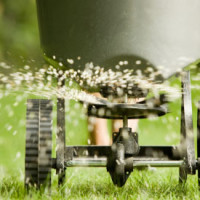
fertilizer-spreader11 When mowing, keep the lawn at the height recommended for that species of grass (usually 2.5”-3”). Keeping lawns at lower height has the potential to increase the disease severity. Soil pH also affects the severity of the disease; if the pH is less than 6.0, the lawn needs an application of lime.

If the disease persists, the use of a fungicide may be necessary to truly fight the fungus. As with all pesticides, it is best to have a trained and licensed applicator apply it. There are several fungicides available to fight Brown Patch. Your lawn care provider will be able to recommend that one that is best for your situation.

Allentuck Landscaping Co. is available for all of your lawn care and landscape needs.

Phone: 3015-515-1900   Email: info@allentucklandscaping.com

Allentuck Landscaping Co. is Your Residential Landscape Company proudly serving Chevy Chase, Bethesda, Potomac, Darnestown, North Potomac, Rockville, Gaithersburg, Boyds, Germantown, Clarksburg, Ijamsville and Urbana.

Front Walkway Ideas That Boost Curb Appeal (With Real Budget Ranges)

Your Front Walkway Sets the Tone for Your Home Your front walkway is more than just a path—it’s the first impression of your home. It guides guests to your door, improves safety, and plays a major role in curb appeal. The question most homeowners ask:What does a front walkway cost—and what can I actually get for my budget? Below, we break down popular front walkway ideas, realistic budget ranges, and what drives pricing so you can plan with confidence. What

READ MORE »

This Is 40: The Story of Allentuck Landscaping 40th Anniversary

In 1986, Allentuck Landscaping Co. was founded on something simple: hard work and the desire to build something meaningful. But the story starts even earlier. When Bruce was just 15 years old, he and his best friends wanted to work. They started a small neighborhood business—“Odd Jobs Unlimited”—mowing lawns and taking on whatever projects they could find. At one point, they had nine kids working for them. It was scrappy, resourceful, and fueled by initiative. That entrepreneurial spirit never left.

READ MORE »

Protecting and Caring for Mature Trees in Your Landscape

Mature trees are one of the most valuable elements of any landscape. They provide shade, seasonal beauty, habitat for wildlife, and a sense of character that simply can’t be replicated overnight. But while trees often appear strong and self-sufficient, they benefit greatly from thoughtful care—especially when landscaping projects or property improvements are involved. With the right approach, you can protect the health of your trees while enhancing the beauty and functionality of your outdoor space. Why Mature Trees Deserve Special

READ MORE »

Top March Garden Tips: Getting Your Landscape Ready for Spring

March marks the official start of spring, bringing longer days, warmer temperatures, and the perfect opportunity to get your garden in shape for the growing season. With plants waking up from dormancy and new growth emerging, now is the time to tackle essential gardening tasks. Follow these top March garden tips to prepare your landscape for a thriving and productive year. 1. Clean Up Your Garden and Prepare for Growth As winter fades away, take time to clear out debris

READ MORE »

Does Snow Damage Landscape Plants?

Branches are drooping. Evergreens are buried. Your garden suddenly looks like it’s been flattened overnight. And the question hits fast: Does snow damage landscape plants? Sometimes yes. Often no.The real answer depends on what kind of snow you get, what plants you have, and whether you step in at the right moment—or make things worse by doing too much. Let’s break it down in a simple, homeowner-friendly way. Does Snow Damage Landscape Plants in Winter? Most of the time, snow

READ MORE »

Top February Garden Tips: Preparing for Spring Growth

February is a crucial month for gardeners, making it the perfect time to focus on the top February garden tips to prepare for the upcoming spring season. While winter still lingers, small signs of new growth begin to appear, signaling that it’s time to start planning, pruning, and protecting your landscape. By tackling key gardening tasks now, you’ll set the stage for a vibrant and thriving garden in the months ahead. 1. Prune Trees and Shrubs: Top February Garden Tips

READ MORE »