
Seguridad del extintor de incendios
Cómo extinguir pequeños incendios de forma adecuada
Los extintores de incendios están diseñados para extinguir incendios pequeños en sus primeras etapas cuando el fuego presenta un riesgo relativamente menor para el operador.
Un extintor puede utilizarse en lo que se conoce como etapa incipiente, es decir, cuando el fuego:
- Es leve.
- Aumenta lentamente.
- Hay poco humo.
- Hay poco calor.
Si el fuego es demasiado extenso, si hay mucho humo o si usted está muy asustado, evacue de inmediato.
PASS
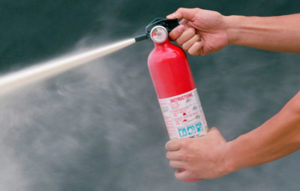
Para operar un extintor de incendios usamos la palabra PASS. Cada letra representa una de las operaciones:
P=Pull (Tirar)
- La clavija de seguridad generalmente se encuentra sujetada mediante un sello de plástico del cual deberá tirar.
- No presione hacia abajo la palanca de operación mientras tira de la clavija, ya que no saldrá.
A=Aim (Apuntar)
- Apunte hacia la base del fuego, la llama más inferior que se encuentre cerca de usted.
- La base del fuego se alejará de usted a medida que use el extintor, de modo que debe ajustar el enfoque.
S=Squeeze (Apretar)
- La palanca de operación está por encima de la manija de transporte. La palanca de operación abre la válvula cuando se aprieta. Cuando se suelta, la válvula se cierra y la descarga se interrumpe.
S=Sweep (Pasar de lado a lado)
- Pase la boquilla de lado a lado moviendo el brazo a la altura de los codos.
- Dirija la descarga para cubrir todo el ancho de la base del fuego.
Conozca las reglas
Usar el extintor de incendios incorrecto puede producir más daño que el incendio mismo. Todos los extintores tienen placas de identificación con las instrucciones de uso, según lo descrito a continuación.
Incendios de Clase A
- Incluye los incendios de madera, papel, basura y otros elementos que producen rescoldos encendidos a medida que se queman.
- Solo use un extintor de Clase A para estos elementos y nunca utilice uno para un incendio de origen eléctrico o por gasolina.
Incendios de Clase B
- Incluye los incendios por gasolina y líquidos inflamables (gasolina, diluyentes de pintura, solventes, grasa y acetileno).
- Solo use un extintor de Clase B para extinguir estos incendios.
Incendios de Clase C
- Incluye los incendios de equipos eléctricos.
- Solo use un extintor de Clase C para extinguir estos incendios.
Saber Cuándo Ir
Nunca sientas que tienes que quedarte y luchar contra un incendio. Si en algún momento mientras usa un extinguidor se siente incómodo con la situación o siente que su seguridad está amenazada, salga inmediatamente. Tu vida vale más que cualquier propiedad.
Fire Extinguisher Safety
Properly fighting small fires
Fire extinguishers are designed to fight small fires in their early stages when the fire presents a relatively small hazard to the operator.
An extinguisher can be used in the incipient stage, when the fire is:
- Small
- Slow growing
- Minimal smoke
- Minimal heat
If a fire is too large, if there is too much smoke or if you are too frightened, evacuate immediately.
PASS
To operate a fire extinguisher, use the PASS method:
P=Pull
- The safety pin is usually held in place by a plastic seal, it will pull off. Do not push down on the operating lever while pulling the pin, it won’t come out.
A=Aim
- Aim at the base of the fire, the lowest flame closest to you. The base of the fire will recede from you as you use the extinguisher, so you must adjust your aim.
S=Squeeze
- The operating lever is above the carrying handle. The operating lever opens the valve when you squeeze it down. When you let go, the valve closes and the discharge stops
S=Sweep
- Sweep the nozzle by moving your arm at the elbow. Direct the discharge to cover the entire width of the base of the fire.
Know Your A, B, Cs
Using the wrong fire extinguisher can result in more damage than the fire itself. All extinguishers have nameplates identifying their usage instructions, as outlined below.
Class A Fires
- Include wood, paper, trash and other items that produce glowing embers as they burn
- Only use a Class A extinguisher for these items and never use one on a gas or electrical fire.
Class B Fires
- Include flammable liquid and gas fires (gasoline, paint thinners, solvents, grease and acetylene)
- Use a Class B extinguisher only to fight these fires.
Class C Fires
- Include energized electrical equipment fires
- Use a Class C extinguisher only to fight these fires.
Know When To Go
Never feel like you have to stay and fight a fire. If at any point while using an extinguisher you become uncomfortable with the situation or feel like your safety is threatened, get out immediately. Your life is worth more than any property.