
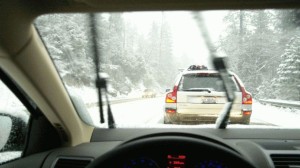
Winter weather is on its way to Montgomery County. Make sure your are prepared.
Reprinted from the Weather Channel
Every winter, people are injured or killed because they are unprepared or overconfident on snowy, icy roads. Even if you are a veteran driver from a Snow Belt state and don’t give venturing out in a blizzard a second thought, keeping these safety tips fresh in your mind can keep you on the road and in control.
Make sure you and your car are properly equipped
Before you set out on a snowy trip, even if it’s just a short drive to the grocery store, keep the following items in mind.
- Make sure that your car has ample antifreeze, the windshield is clean and you have plenty of windshield washer fluid.
- Check to make sure the headlights are clean and in working order.
- Verify that the tires have tread and are properly inflated.
- Have your battery tested, to avoid being stranded in the cold with a car that won’t start.
- Equip your car with a flashlight and extra batteries, a first aid kit, warm clothes, and a blanket.
- Remember to have sunglasses in the car, as the glare of the sun off of snow and ice can be more intense in the winter than it is in the summer.
- Perhaps the most important of all: Remember your cell phone, so you can call in case of emergency.
Slow down and drive smoothly
Driving too quickly is the main cause of accidents in winter conditions. Even if you’re driving an SUV or a four-wheel-drive vehicle, you cannot safely do 80 mph during a snowstorm. Regardless of your vehicle, how you drive can prevent accidents.
- Avoid abrupt acceleration, braking and unnecessary lane changes. These maneuvers can cause your vehicle to lose traction and can launch you into an uncontrollable skid, leading to a collision.
- Four-wheel-drive may help your vehicle get going in the slushy stuff, but it’s of no use when you’re trying to steer or safely stop on a slippery road surface.
- Be patient and accept the fact that it is going to take longer to arrive at your destination.
Do not tailgate
Tailgating often leads to accidents, especially if you are driving in stop-and-go traffic. You may think that the driver in front of you doing 35 mph on the freeway is going too slow and needs a reminder in the form of you riding their bumper, but doing so is dangerous.
- Be patient and stay well behind the driver in front of you until it’s safe to pass.
- It is important to remember that it takes a much longer distance to stop your vehicle in the snow or ice due to the reduced traction, even with just a light covering on the road.
- Having to deal with a fender bender on a busy road in the snow is certainly something that you want to avoid, especially if other cars are sliding around as well.
- Many serious accident injuries come from a second impact from another car after a seemingly trivial collision.
Do not use cruise control
Driving with cruise control has become almost second nature. Sure, it prevents you from getting leg fatigue, keeps you from unwittingly speeding and is great on long trips, but driving with it on in winter conditions can be unsafe.
- If cruise control has become a staple of your driving habits, make a conscious effort to ensure that you are not using it in winter weather.
- Using cruise control in the snow, ice or even rain is dangerous because if your car hydroplanes or skids, the car can accelerate and spin the wheels, attempting to maintain a constant speed.
- If you hydroplane with cruise control on, it will be more likely that you lose control of your vehicle.
Pull over or stay home
Remember, there is no shame in making the logical decision to stay in when the conditions are bad. You may be late arriving to your destination, but arriving late in one piece is much better than the alternative.
- If you can postpone your trip, or if it is non-essential, stay in when the weather is really bad.
- If at any point during your trip you feel that the weather is too bad to continue driving, simply stay put.
- If you’re out on the road, find a safe spot to pull over and wait until the weather passes or calms to the point where you feel comfortable driving again.
- If driving in bad weather conditions is fatiguing, switch drivers before you get tired.
Related Post: Our Annual Ice Melt Product Survey
Remember, Allentuck Landscaping Co. is always here to help you design, install, construct and maintain you lawn and landscape. Now is the time to get your 2016 Lawn and Landscape Maintenance Quote. Give us a call!
Allentuck Landscaping Co. is Your Residential Landscape Company
Phone: 301-515-1900
Email: info@allentucklandscaping.com
Proudly serving Chevy Chase, Bethesda, Potomac, Darnestown, North Potomac, Rockville, Gaithersburg, Boyds, Germantown, Clarksburg, Ijamsville and Urbana.