

Spotted Lanternfly Is Heading To Our Area
A new non-native invasive insect pest is moving towards our area and is a serious threat to landscape plants, forest trees and agricultural crops.
The Spotted Lanternfly is a leafhopper originally native to China, India and Vietnam. It was first spotted in the United States around 2014 in Pennsylvania. Populations have since been confirmed in Delaware, New Jersey and Virginia. For the first time, it was recently spotted in Maryland.
What Does The Spotted Lanternfly Look Like?
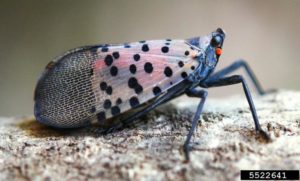 The spotted lanternfly adult is about 2.5 cm (1 inch) in length. The fore wings are greyish-brown with black spots, with the wing tips having a darker, brick-and-mortar pattern. The hind wings are mainly red with black spots, followed by a white band and a black tip. When the spotted lanternfly is at rest, a hint of the red color can be observed through the forewings, but the color is especially noticeable when it is in flight. The body is mainly black, but the abdomen appears to be mostly yellow with black bands going down its length.
Spotted Lanternfly Life Cycle
Adults are active from July until the start of winter. They will mate in late fall and the female will begin laying eggs. They prefer to lay their eggs on the Tree-Of-Heaven (Ailanthus altissima) but will lay eggs on other trees, stones, outdoor furniture or any other vertical surface. The eggs are laid in masses of 30-50 eggs and coated with a waxy gray film. When dry, it looks like a splash of mud making difficult to identify. The eggs hatch in late April to early May. The nymphs are small and are black with white spots when they first hatch. As the nymphs mature, they start to show red coloring, especially around their head, abdomen, and wing pads.
One interesting habit that has been noticed is that the nymphs have a tendency to crawl up the tree 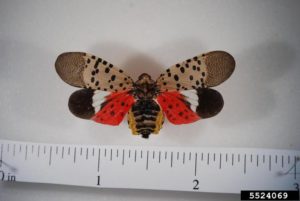 in the morning and back down in the evening. This can be very noticeable because the nymphs tend to congregate in large groups.
Plants Damaged By Spotted Lanternfly
Although the Spotted Lanternfly prefers the Tree Of Heaven, it will cause damage to many other plants. It has been spotted on over 70 species of plants including American beech (Fagus grandifolia), American linden (Tilia americana), American sycamore (Platanus occidentalis), big-toothed aspen (Populus grandidentata), black birch (Betula lenta), black cherry (Prunus serotina), black gum (Nyssa sylvatica), black walnut (Juglans nigra), dogwood (Cornus spp.), Japanese snowbell (Styrax japonicus), maple (Acer spp.), oak (Quercus spp.), paper birch (Betula papyrifera), pignut hickory (Carya glabra), sassafras (Sassafras albidum), serviceberry (Amelanchier canadensis), slippery elm (Ulmus rubra), tulip poplar (Liriodendron tulipifera), white ash (Fraxinus americana), and willow (Salix spp.).
Damage To Plants
Spotted Lanternflies damage plants in two different ways. The nymphs and adults feed on plants using their piercing mouthparts to suck fluids from the stems or leaves. This has been shown to cause stunted growth, localized damage, reduced yields, and, in extreme cases, even death of the plant. Additionally, as the spotted lanternfly feeds, it excretes a sugary substance called honeydew. This honeydew, in addition to being attractive to ants, wasps, and other insects, is readily colonized by sooty mold, which can cause parts of the plants to become blackened, reducing photosynthesis and affecting the quality of the plants. In large populations of Spotted Lanternflies, plants can be absolutely covered by the honeydew and sooty mold.
How To Control Spotted Lanternfly
There are a few strategies to control Spotted Lanternfly:
- Remove Tree Of Heaven plants from your property.
- If you notice the egg masses on surfaces, destroy them.
- When there are only a few insects, you can kill spotted lanternflies by swatting or crushing them.
- If there are large populations, there are several contact and systemic insecticides available that will kill them. As with all pesticides, follow label instructions or hire a licensed professional.
*Adapted from the Maryland Department of Agriculture. Photo credit the Maryland Department of Agriculture.
Remember, Allentuck Landscaping Company is always here to help you design, install, construct and maintain you lawn and landscape. Give us a call!
Allentuck Landscaping Co. is Your Residential Landscape Company
Phone: 301-515-1900 Email: info@allentucklandscaping.com
At Allentuck Landscaping Company, our mission is to create beautiful environments for people to enjoy. We see landscaping as a way to improve people’s lives.
The Allentuck Landscaping Company team has been delighting homeowners in Maryland, Washington DC and Northern Virginia for over 28 years with our turnkey approach to landscape design, installation, construction and maintenance. Most companies try to serve many types of customers at the same time; homeowners, shopping centers, office buildings and the list goes on. At Allentuck Landscaping Company, we focus on one customer, you, the homeowner. We have a singular focus on bringing you the best landscape practices, the best customer service, and the best value for your home.
Services Provide – Master Landscape Plans, Complete Maintenance Programs, Plantings, Patios, Walkways, Retaining Walls, Water Features, Outdoor Lighting, Outdoor Kitchens, Trellises & Pergolas, Irrigation Systems, Drainage Solutions, Grading & Sodding. Fire Pits & Fire Places, Spring Clean Ups, Decks, Fences
Areas Served – Chevy Chase, Bethesda, Potomac, Rockville, North Potomac, Darnestown, Gaithersburg, Germantown, Boyds, Clarksburg, Ijamsville, Urbana, Frederick and Washington DC.