
Please ensure Javascript is enabled for purposes of website accessibility

Why Do I Have Brown Areas In My Lawn?

Fertilizer spreader

Brown Patch Thrives in Summer Time

If you have brown patches mysteriously appearing in your lawn around this time of the year, chance are fairly good that your grass has a fungus commonly referred to as Brown Patch. Brown Patch thrives in hot, humid conditions, exactly the weather we have right now.

How To Recognize Brown Patch

It initially starts out with a slight purple appearance with “smoke ring” edges, turning a dull brown as the diseases progresses. Upon inspection of the blades of grass, one can find tan lesions which may develop reddish-brown margins. Areas that are totally killed by the fungus will appear light brown, or straw colored, and be very brittle to the touch.

Summer is the optimal time for Brown Patch in Montgomery County, Maryland and other Mid-Atlantic areas. It thrives when temperatures are in the range of 75° to 95° F, with the optimal conditions for leaf colonization being temperatures of 85° to 90° F with high humidity or extended leaf wetness periods.

What To Do

Early identification is key to successful treatment. Brown Patch thrives when lawns have excess moisture (overwatering, high rain or humidity), and will continue to spread during the growing season if conditions do not change. Most people will apply fertilizer when they see dying lawn areas but this only fuels the problem.

Controlling the moisture level is important. While we cannot control what nature gives us or the humidity, we can control how much water we apply using sprinklers or irrigation systems. If Brown Patch is a problem, water should only be applied when it is needed. Watering in the early morning will allow the grass to completely dry before evening, thus limiting the amount of time that the lawn is wet. Watering in the late afternoon and evening should always be avoided. Aerating the lawn will allow the water to soak through to the roots faster.
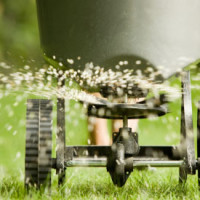
fertilizer-spreader11 When mowing, keep the lawn at the height recommended for that species of grass (usually 2.5”-3”). Keeping lawns at lower height has the potential to increase the disease severity. Soil pH also affects the severity of the disease; if the pH is less than 6.0, the lawn needs an application of lime.

If the disease persists, the use of a fungicide may be necessary to truly fight the fungus. As with all pesticides, it is best to have a trained and licensed applicator apply it. There are several fungicides available to fight Brown Patch. Your lawn care provider will be able to recommend that one that is best for your situation.

Allentuck Landscaping Co. is available for all of your lawn care and landscape needs.

Phone: 3015-515-1900   Email: info@allentucklandscaping.com

Allentuck Landscaping Co. is Your Residential Landscape Company proudly serving Chevy Chase, Bethesda, Potomac, Darnestown, North Potomac, Rockville, Gaithersburg, Boyds, Germantown, Clarksburg, Ijamsville and Urbana.

Top September Garden Tips: Transitioning from Summer to Fall

September marks the shift from hot summer days to cooler autumn evenings—a welcome change for both gardeners and their landscapes. While your garden may still be full of late-summer blooms and harvests, it’s also the perfect time to prepare for fall. These Top September Garden Tips will help you enjoy the last of summer’s bounty while getting your landscape ready for the season ahead. 1. Refresh and Revive Your Lawn Lawns often feel the stress of summer heat and foot

READ MORE »

How Much Does An Outdoor Kitchen Cost in the Rockville, MD Area?

Outdoor kitchens have gone way beyond a simple grill on the patio. They’ve become full-on extensions of the home—places to cook, relax, and entertain. If you’re thinking about building one, the first thing on your mind is probably the same question we hear from almost every homeowner: How much does an outdoor kitchen cost in the Rockville, MD area? The short answer: it depends on size, features, and materials. The longer answer: you’ll want to know what actually drives the

READ MORE »

Gardens For Grade School Grants: Helping North Potomac Schools Start the Year Fresh

The first day of school comes with a special kind of energy—kids carrying brand new backpacks, parents juggling first-day photos, and teachers ready to welcome their students. At Allentuck Landscaping Co., we believe the outside of a school should reflect that same sense of excitement. That’s exactly why, for the seventh year in a row, we launched our Gardens For Grade School Grants program. This year we partnered with Dufief Elementary School and Travilah Elementary School in North Potomac, MD.

READ MORE »

Caring For Your Outdoor Fire Feature

If you’re lucky enough to have an outdoor fire feature, you’re doing something right. But caring for your outdoor fire feature isn’t just about looks—it’s about keeping those flames safe, reliable, and downright inviting. Because when the day cools off, it should be the crackle and glow drawing people in, not worry. Why Caring For Your Outdoor Fire Feature Matters Let’s face it: a fire feature is way more than a decorative element—it’s where memories happen. A well-maintained fire feature

READ MORE »

How Long Should Pressure Treated Timbers Last?

You’ve just invested in a new retaining wall, garden edging, or set of steps. It looks solid. Feels sturdy. And you’re thinking, this should last forever. But here’s the reality: even the best pressure treated timbers have a shelf life. The big question—how long should pressure treated timbers last—comes down to more than just the wood itself. Where you put it, how it’s installed, and how you care for it all make a huge difference. Some timbers can keep going

READ MORE »

Top August Garden Tips: Setting Yourself Up for a Brilliant Fall

Landscaping is a long game, and these top August garden tips are all about playing it smart. What you do now sets the stage for a healthier, better-looking yard this fall—and even next spring. If your landscape’s looking a little tired, we can help bring it back to life. We’ve been doing this for 35+ years and know how to turn late-summer blah into fall brilliance. 1. Refresh Mulch and Cut Back Overgrowth By August, mulch starts to fade, thin

READ MORE »