
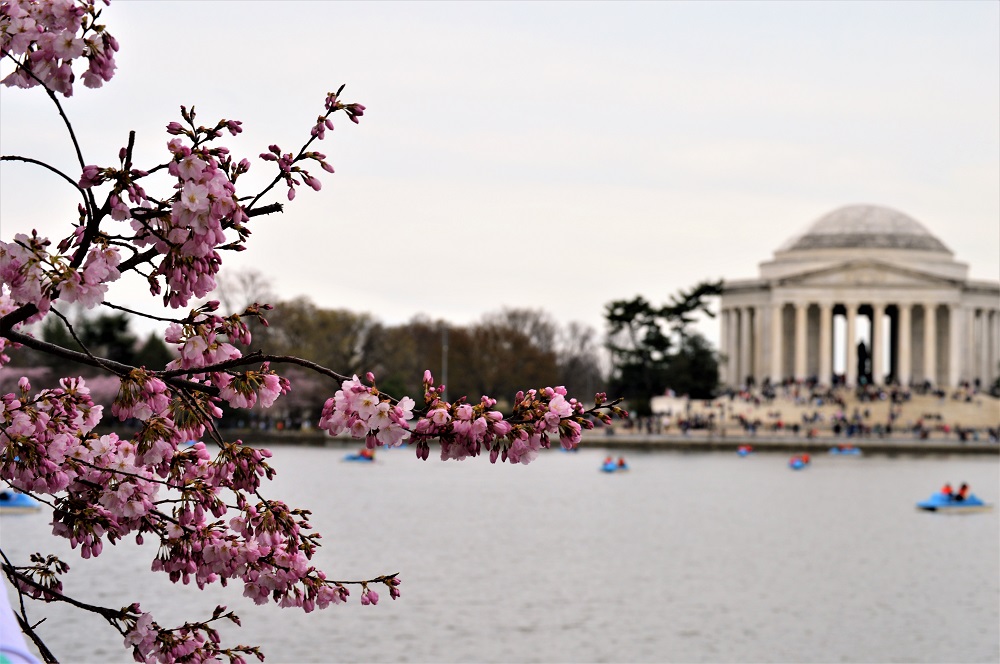
Do Not Miss The Cherry Blossoms!
Living in Washington DC, we know how special the cherry blossoms around the Tidal Basin are. Each year, millions of people flock to Washington DC to take in what we sometimes take for granted. The much anticipated peak bloom time is subject to many expert predictions with the weather playing a huge factor into just when the trees will be at their best.
A Brief History
Each year, the National Cherry Blossom Festival commemorates the 1912 gift of 3,000 cherry trees from Mayor Yukio Ozaki of Tokyo to the city of Washington, DC. The gift and annual celebration honor the lasting friendship between the United States and Japan and the continued close relationship between the two countries.
It took the coordination of many to ensure the arrival of the cherry trees. A first batch of 2,000 trees arrived diseased in 1910, but did not deter the parties. Between the governments of the two countries, coordination by Dr. Jokichi Takamine, a world-famous chemist and the founder of Sankyo Co., Ltd. (today known as Daiichi Sankyo), Dr. David Fairchild of the U.S. Department of Agriculture, Eliza Scidmore, first female board member of the National Geographic Society, and First Lady Helen Herron Taft, more than 3,000 trees arrived in Washington in 1912. In a simple ceremony on March 27, 1912, First Lady Helen Herron Taft and Viscountess Chinda, wife of the Japanese ambassador, planted the first two trees from Japan on the north bank of the Tidal Basin in West Potomac Park.
Over the years, gifts have been exchanged between the two countries. In 1915, the United States Government reciprocated with a gift of flowering dogwood trees to the people of Japan. In 1981, the cycle of giving came full circle. Japanese horticulturists were given cuttings from the trees to replace some cherry trees in Japan which had been destroyed in a flood.
About The Cherry Trees
The Cherry Tree that is the star of the National Cherry Blossom Festival is Yoshino Cherry (Prunus x yedoensis). This stand-out tree is, of course, known for its vibrant display of white-pink blossoms and faint almond fragrance in the springtime. In the summer, this tree will be a highlight in the yard with its oriental branching pattern, glossy bark and dark green leaves.
An excellent ornamental tree, it grows to 20 feet and its trunk is marked by horizontal lines of white lenticels. Its upright horizontal branching makes it ideal for planting over walkways and patios.
A nice bonus to the stunning flowers is the wonderful, almond-like smell they give off. Light spring breezes will carry the scent throughout your yard.
Other Cherry Trees To Consider
Prunus ‘Okame’
‘Okame’ fills its many branches with rosy pink blossoms in very early spring for several weeks. Its leaves bronze and orange in the autumn. It delightfully blooms earlier than most other species, around the same time the Winter Jasmines and Witch Hazels are at their peak.
Prunus kwanzan ‘Serrulata’
A deeper pink than ‘Yoshino’, this tree is a profuse bloomer. Its bark is also darker, almost like chocolate, which makes the white lenticels stand out even more. An upright, vase-shaped branching habit perfect for lining a road or driveway, or as a stunning lawn specimen. Truly a lovely specie.
Prunus subhirtella ‘Pendula’
The Weeping Higan Cherry adds a unique form to the landscaping. Use this tree as a focal point or in pairs to highlight an entrance. A must in any Japanese style garden. Large magenta buds along the graceful weeping branches give way to a splendid pink blossom.
Prunus ‘Snofozam’
The name of this plant says it all, Snow Fountains Weeping Cherry. Cascading branches that dip all the way to the ground are literally covered with snowy white flowers in the spring. The fall color is not to be outdone with leaves ranging from shades of gold to orange.
Sources:
https://www.nationalcherryblossomfestival.org/about/history/
https://www.arborday.org/trees/treeguide/TreeDetail.cfm?ItemID=812
Allentuck Landscaping Co. is Your Residential Landscape Company
Phone: 301-515-1900 Email: info@allentucklandscaping.com

At Allentuck Landscaping Company, our mission is to create beautiful environments for people to enjoy. We see landscaping as a way to improve people’s lives.
The Allentuck Landscaping Company team has been a leading landscape company in Montgomery County, Maryland for over 28 years with our turnkey approach to landscape design, installation, construction and maintenance. Most companies try to serve many types of customers at the same time; homeowners, shopping centers, office buildings and the list goes on. At Allentuck Landscaping Co., we focus on one customer, you, the homeowner. We have a singular focus on bringing you the best landscape practices, the best customer service, and the best value for your home.
Services Provide – Master Landscape Plans, Complete Maintenance Programs, Plantings, Patios, Walkways, Retaining Walls, Water Features, Outdoor Lighting, Outdoor Kitchens, Trellises & Pergolas, Irrigation Systems, Drainage Solutions, Grading & Sodding. Fire Pits & Fire Places, Spring Clean Ups, Decks, Fences, Mosquito & Tick Control, Deer Control.
Areas Served – Chevy Chase, Bethesda, Potomac, Rockville, North Potomac, Darnestown, Gaithersburg, Germantown, Damascus, Boyds, Clarksburg, Ijamsville, Urbana, Frederick in Maryland and Washington DC.